Our teaching of English includes phonics, reading, writing, spelling, handwriting and grammar. Children in Key Stages One and Two have a daily writing lesson. Children in EYFS have a number of shorter inputs that feed into the writing curriculum, though the structure and timing of this teaching will depend on the topic and the time of year. Each child in Reception writes with their teacher at least once a week in addition to their phonics lesson.
Our teaching of writing changes as children move through school:
In Reception, children write predominantly in their phonic range, writing dictated words, phrases and sentences to apply the phonic and spelling patterns that they learn in Read, Write Inc. Where children need spellings and vocabulary outside of their phonic range, we provide the word for them. Sometimes their writing is linked to their topic or story work. Sometimes it is not.
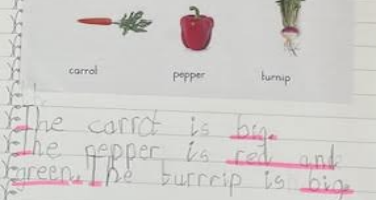
In Y1, when children begin to compose and write their own sentences, we explicitly teach them how to form sentences by using an approach inspired by colourful semantics. This approach carries on into the beginning of Y2.
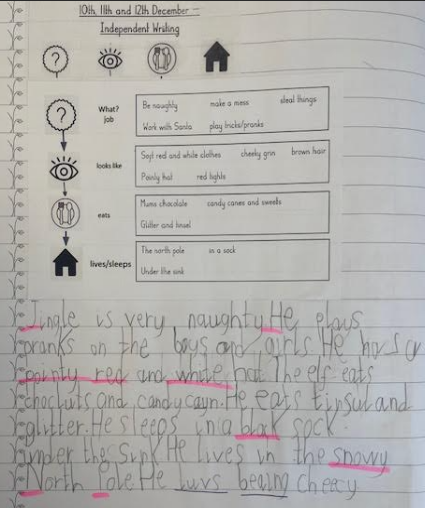
From part way through Y2 to the end of Y6, we use a phased approach to teach a unit of writing. Our long-term plans for writing and a summary of the phased approach can be found below.
Our curriculum for writing is inspired by beautiful picture books, content in the wider curriculum, special events, novels, films and quality teacher models. Children write narrative pieces (most often stories) and transactional pieces (reports, instructions, letters, leaflets etc.) each year, returning to the conventions of different text types multiple times throughout their time with us.
We teach handwriting using the Kinetic Letters approach. It is designed to get pupils writing fluently, confidently and beautifully from the start, teaching all conventions of print as children learn to write. Children in EYFS and KS1 have a daily Kinetic Letters lesson. As pupils move up through school, the amount of time spent on handwriting depends on cohorts’ needs.
We teach spelling using the Read, Write, Inc. spelling approach, which we have supplemented with extra resources to give children further practice of the most common words and patterns that they need to spell. Spelling is taught a minimum of three times per week from Y2 in addition to daily phonics lessons for those who need them.
We teach grammar in two ways: integrated into the writing sequence where it is appropriate, and discretely in short bursts for content that doesn't quite fit the units taught.
Helpful Documents
